
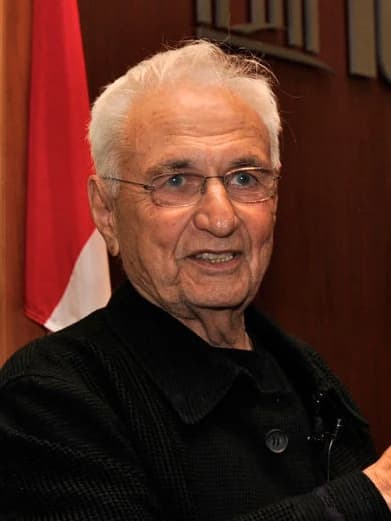
Designer
Frank Gehry
Frank Gehry was born in Toronto, Canada, in 1929 according to Vitra's biography; Wikipedia gives 28 February 1929 for the birth of Ephraim Owen Goldberg, who took the name Gehry in 1954, though its opening line says 1930. His family…
Biography
Background
Frank Gehry was born in Toronto, Canada, in 1929 according to Vitra's biography; Wikipedia gives 28 February 1929 for the birth of Ephraim Owen Goldberg, who took the name Gehry in 1954, though its opening line says 1930. His family settled in California in 1947. He studied at Los Angeles City College and graduated from the University of Southern California's School of Architecture in 1954, and Vitra adds urban planning studies at Harvard University's Graduate School of Design. In 1962 he founded the practice that became Frank Gehry & Associates in Los Angeles. Wikipedia reports that he died at his home in Santa Monica on 5 December 2025, aged 96.
Signature Style
Wikipedia describes a body of work that defies categorisation and reflects a spirit of experimentation. Gehry used corrugated steel, chain-link fencing and unpainted plywood, everyday materials whose use the article says was partly inspired by Saturday mornings in his grandfather's hardware store, and it connects his work to the California "funk" art of the 1960s and early 1970s. Fish became a recurring motif from the mid-1980s, and the article counts him among the first architects to grasp the potential of computer design.
Notable Works
Buildings named by Wikipedia include the Guggenheim Museum Bilbao (1997), the Walt Disney Concert Hall in Los Angeles (2003) and the Fondation Louis Vuitton in Paris (2014). For Vitra he designed the Vitra Design Museum and the manufacturing facility in Weil am Rhein (1989), his first buildings in Europe, and the Vitra Center in Birsfelden near Basel (1994). In furniture, Vitra lists the cardboard series Easy Edges of 1969 to 1972; its Wiggle Side Chair page counts the chair as part of it.
Legacy
Gehry won the Pritzker Architecture Prize in 1989. Critics coined the "Bilbao effect" for the way his Bilbao museum revitalised the city, and the Guardian's obituary, as Wikipedia quotes it, called him the most recognisable American architect since Frank Lloyd Wright.