
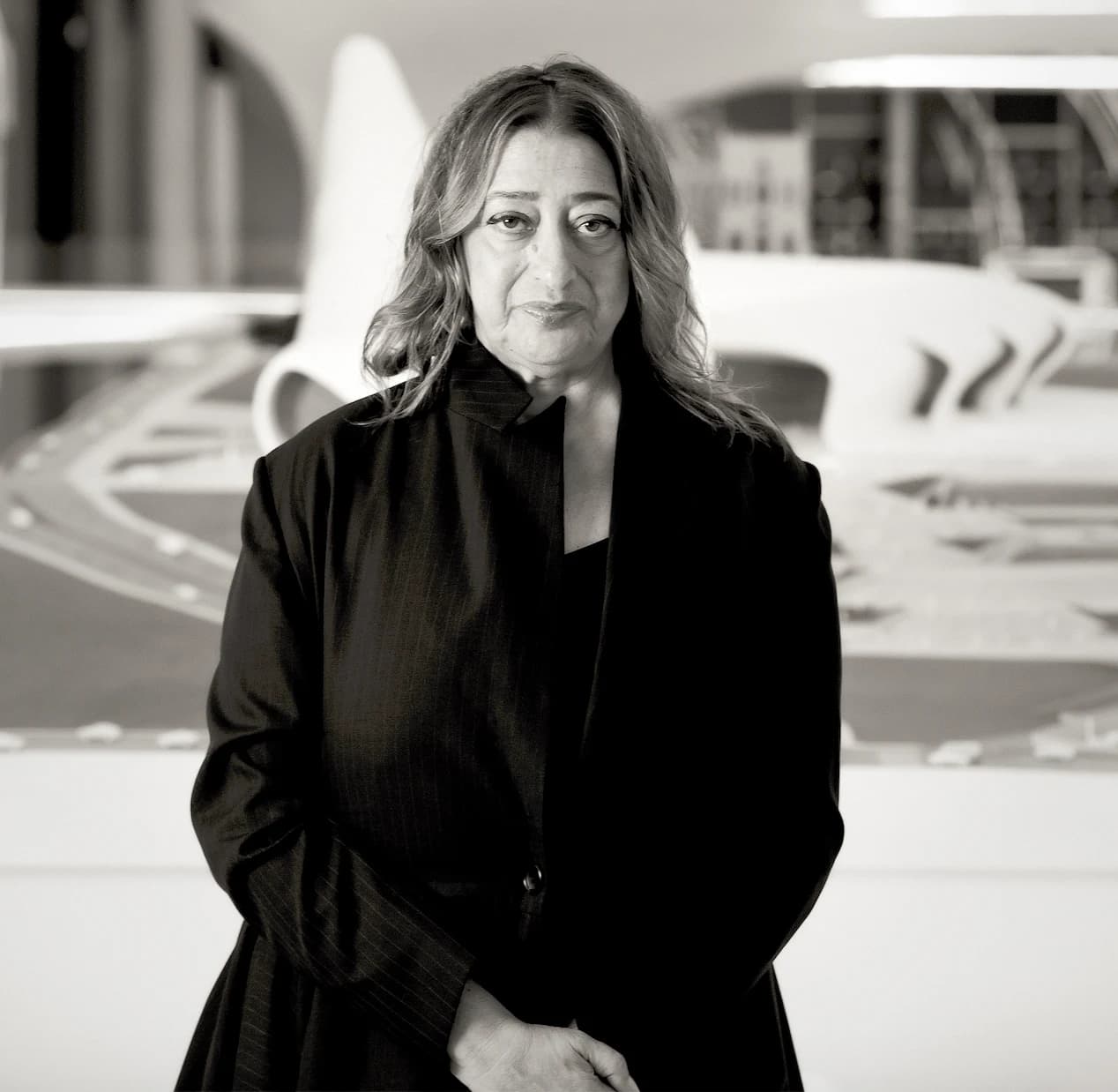
Designer
Zaha Hadid
Dame Zaha Hadid (31 October 1950, Baghdad – 31 March 2016, Miami) was an Iraqi and British architect, artist and designer. She studied mathematics at the American University of Beirut and moved to London in 1972 to study at the…
Biography
Background
Dame Zaha Hadid (31 October 1950, Baghdad – 31 March 2016, Miami) was an Iraqi and British architect, artist and designer. She studied mathematics at the American University of Beirut and moved to London in 1972 to study at the Architectural Association, where she was taught by Rem Koolhaas, Elia Zenghelis and Bernard Tschumi. After working at the Office for Metropolitan Architecture in Rotterdam, she founded Zaha Hadid Architects in London in 1980.
Signature Style
Influenced by Suprematism and the Russian avant-garde, Hadid used painting as a design tool. Her work is known for fragmented geometry and bold fluid forms; The Guardian called her the "Queen of Curves". She was associated with Deconstructivism, and her work has also been described as neo-futurism and parametricism. She once put it simply: the idea is not to have any 90-degree angles.
Notable Works
Buildings include the Vitra Fire Station, MAXXI in Rome, the Guangzhou Opera House, the London Aquatics Centre and the Heydar Aliyev Center. In design she created the Aqua Table and Nekton for Established & Sons, the Moon System sofa for B&B Italia (2007), and the Dune Formations and Liquid Glacial series for David Gill Gallery. In 2006 she founded Zaha Hadid Design.
Legacy
She was the first woman to receive the Pritzker Architecture Prize (2004), won the Stirling Prize in 2010 and 2011, was made a Dame in 2012 and in 2016 became the first woman individually awarded the RIBA Royal Gold Medal.