Designer
Wilton C. Dinges
Wilton Carlyle Dinges founded Emeco (the Electrical Machine and Equipment Company) in 1944 and built it in Hanover, Pennsylvania, employing local steel workers. According to Wikipedia he started with his savings and a used lathe, bidding…
Biography
Background
Wilton Carlyle Dinges founded Emeco (the Electrical Machine and Equipment Company) in 1944 and built it in Hanover, Pennsylvania, employing local steel workers. According to Wikipedia he started with his savings and a used lathe, bidding on government manufacturing contracts, before moving the business to Hanover.
Signature Style
Dinges' work was engineering-led rather than stylistic: Emeco says style "didn't really factor in, but design very much did". For the US Navy he chose aluminum — lightweight, non-corrosive, fire resistant and non-magnetic — and, with Alcoa experts, developed a 77-step process of forming, welding, grinding, heat-treating and anodizing that makes soft scrap aluminum extraordinarily strong.
Notable Works
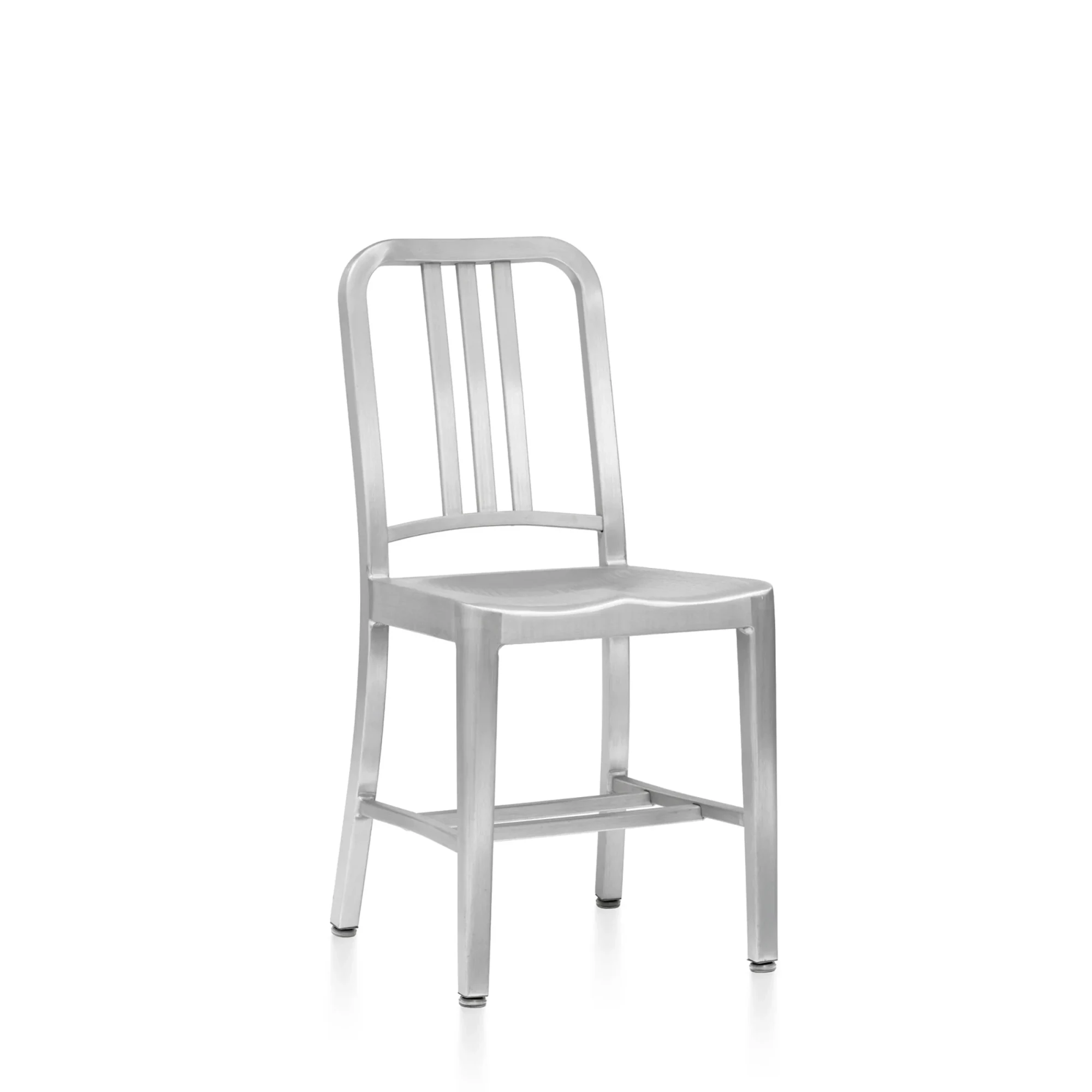
His defining design is the 1006 Navy Chair® (1944), commissioned for warships and submarines. Emeco recounts that he proved its strength to Navy officials by throwing a chair out of a Chicago hotel room window; the unscathed chair sealed the contract.
Legacy
The chair had an estimated life cycle of 150 years, far exceeding the Navy's specifications. Emeco still builds it with the same 77-step process in Hanover and describes it as "proudly unimproved since 1944"; it became the basis for later designer versions such as the Hudson Chair and the 111 Navy Chair.