
Image source: B&B Italia — Hive
© B&B Italia and the respective rights holders. Quoted to accompany INTEBEE's independent design commentary and research.
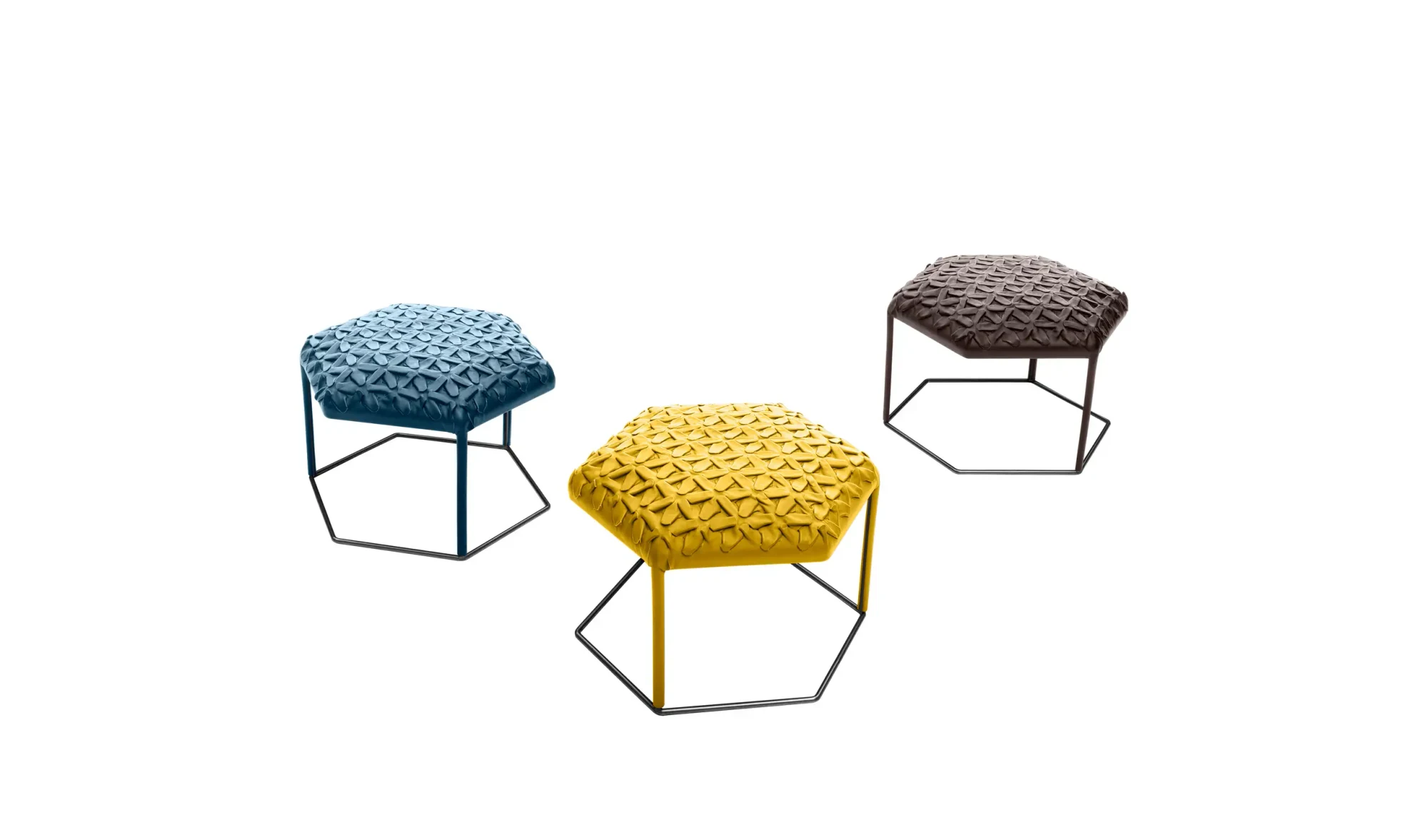
Hive
Ottoman covered in small leather petals left over from production, designed by Atelier Oï in 2013

610 × 425 × 535 mm
2013
Official product information
INTEBEE AI PUBLIC LIBRARY is an independent furniture design research and discovery platform. Product specifications, finishes, availability and other details may change. For current and definitive information, please refer to the manufacturer's official website.
Go to the official product pageSpecifying Hive for your design project?
INTEBEE is the FF&E specification platform for interior designers: spec sheets, finishes, floor plans and client-ready PDFs in one place.
Description
Overview
Hive is an ottoman designed by Atelier Oï in 2013. Its three-dimensional surface comes from the assembly of small leather petals discarded in the manufacturing process. It is described as a green accessory rooted in manual expertise and geometry, inspired by the structure of the beehive.
Construction
The seat is built up from a multi-layered wood panel, shaped polyurethane and polyurethane, with a polypropylene and polyamide cover; the outer cover is Gamma leather. The support frame is drawn steel, the bottom base is thermoplastic material and the ferrules are plastic.
Specifications
Overall size 61 x 53.5 x 42.5 cm (H61P). Gamma leather is offered in 24 colours, and a black chromed metal finish is listed.
Story
What the name refers to
Hive means "beehive". The project evokes the complex structure that small elements can build up into objects of great architectural consistency, as a beehive does.
Leather that was too small to use
Atelier Oï began with the materials, discarded pieces of leather in particular. The studio asked B&B Italia to send the leftover pieces for one week; they were qualitatively perfect but unusable because they were too small, and the designers started working with them. Small petals of leather are sewn together through central incisions that follow a pattern of repeating hexagons. Perfecting the design took two years, and the result looks like a flower and its leaves.