
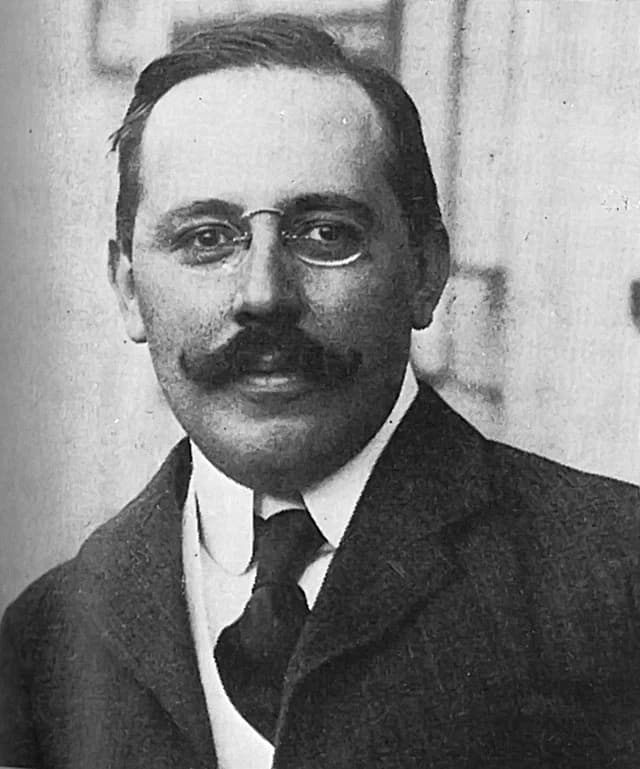
Designer
Josef Hoffmann
Josef Hoffmann (15 December 1870 – 7 May 1956) was an Austrian-Moravian architect and designer, born in Brtnice (Pirnitz), Moravia. He studied at the Higher School of Arts and Crafts in Brno and, from 1892, at the Academy of Fine Arts…
Biography
Background
Josef Hoffmann (15 December 1870 – 7 May 1956) was an Austrian-Moravian architect and designer, born in Brtnice (Pirnitz), Moravia. He studied at the Higher School of Arts and Crafts in Brno and, from 1892, at the Academy of Fine Arts Vienna under Karl von Hasenauer and Otto Wagner; his graduation project won the Prix de Rome.
Signature Style
Hoffmann was among the founders of the Vienna Secession (1897) and in 1903 co-established the Wiener Werkstätte with Koloman Moser and Fritz Wärndorfer, pursuing the Gesamtkunstwerk — architecture, furniture, lamps, glass, metalwork and textiles designed as one. His work grew increasingly rigorous and geometric; his constant use of squares and cubes earned him the nickname "Quadratl-Hoffmann" ("Square Hoffmann").
Notable Works
- Stoclet Palace, Brussels (1905–1911), now a UNESCO World Heritage Site
- Sanatorium Purkersdorf near Vienna (1904–05)
- Sitzmaschine chair (c. 1905) and the Fledermaus chairs for the Cabaret Fledermaus (1907)
- Kubus Armchair (1910), today produced by Wittmann
Legacy
Hoffmann taught at the Kunstgewerbeschule (now the University of Applied Arts Vienna) from 1899 and co-founded the Deutscher Werkbund (1907) and the Austrian Werkbund (1912). Several of his designs remain in production, including the Rundes Modell cutlery by Alessi and a family of upholstered pieces by Wittmann.