
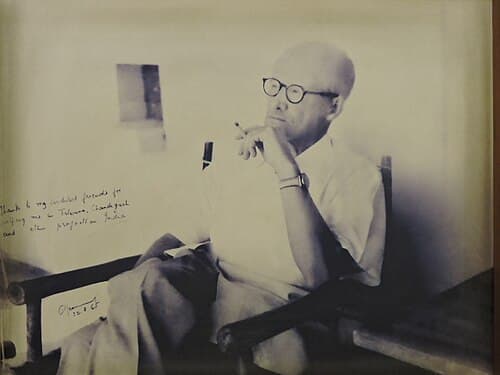
Designer
Pierre Jeanneret
Pierre Jeanneret (1896–1967) was a Swiss architect born in Geneva, where he studied at the École des Beaux-Arts. He was the cousin of Charles-Édouard Jeanneret — Le Corbusier — with whom he set up an architectural practice in 1922 and…
Biografia
Background
Pierre Jeanneret (1896–1967) was a Swiss architect born in Geneva, where he studied at the École des Beaux-Arts. He was the cousin of Charles-Édouard Jeanneret — Le Corbusier — with whom he set up an architectural practice in 1922 and worked for about twenty years.
Signature Style
From 1927 to 1937 the cousins worked with Charlotte Perriand in the rue de Sèvres studio, designing tubular-steel furniture and interiors; in 1929 the trio co-founded the Union des Artistes Modernes. Jeanneret's own furniture explored a pared-down, minimalist construction — including a chair that needed no fasteners.
Notable Works
- LC1, LC2 and LC4 (1928), with Le Corbusier and Charlotte Perriand — produced by Cassina
- Chandigarh, India: mass housing types, Panjab University buildings including Gandhi Bhawan and the library, the State Library and Town Hall
- The Chandigarh chair, with Eulie Chowdhury
Legacy
Jeanneret stayed in Chandigarh as the city's Chief Architect and mentored a generation of Indian architects. His house in Sector 5 is now a museum, and his ashes were scattered in Sukhna Lake.